
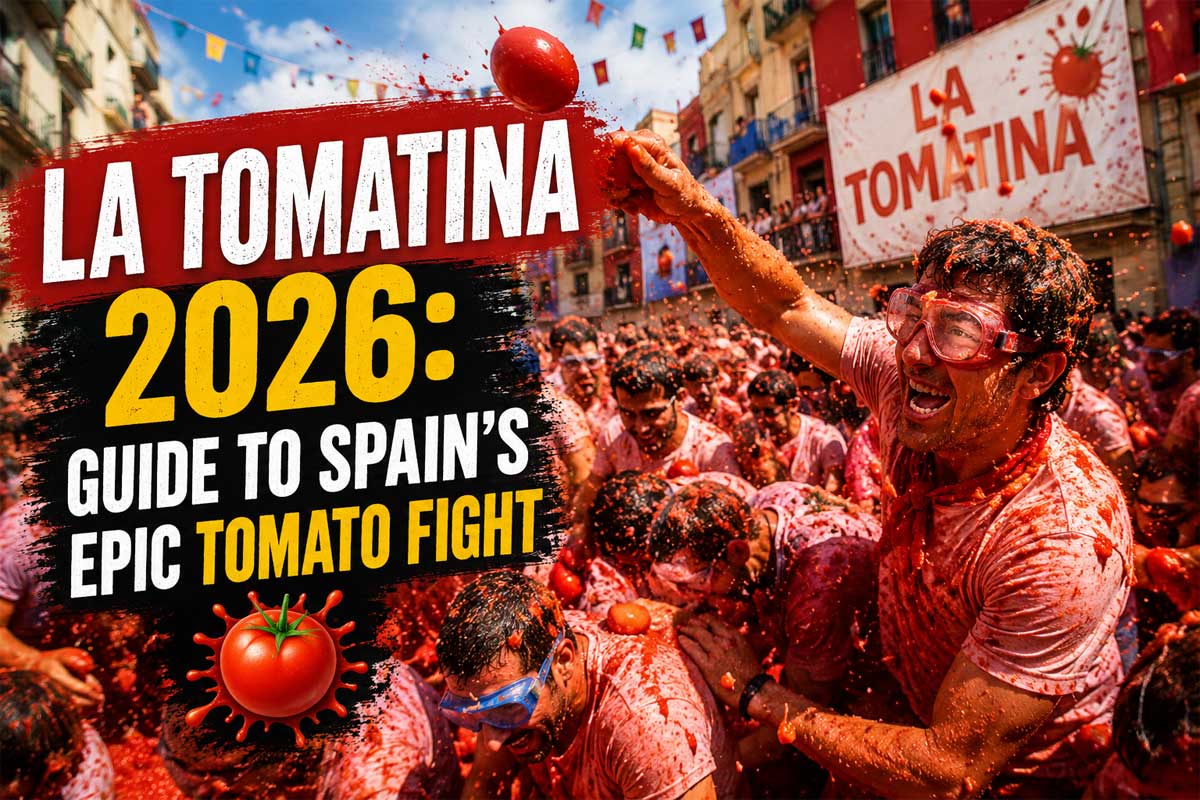
There are travel experiences you watch from a safe distance, and then there’s La Tomatina — a festival that hands you a squashed tomato, points you toward a crowd of twenty thousand strangers, and basically dares you to keep your dignity. Spoiler: you won’t. And that’s exactly the point.
Every year, on the last Wednesday of August, the small town of Buñol near Valencia turns completely, gloriously red. For one hour, the narrow streets become a river of pulp and laughter as people from every corner of the planet hurl overripe tomatoes at each other for no reason other than pure, uncomplicated fun. If you’ve ever wanted to do something that your future self will still be laughing about, this is it.
Here’s everything you actually need to know before you go.
What Is La Tomatina, Really?
Strip away the hype and it’s beautifully simple: La Tomatina is a one-hour tomato fight in the streets of Buñol, where thousands of people throw squashed tomatoes at one another just for the joy of it. There’s no deep symbolism, no ancient ritual to decode, no team you need to root for. It’s chaos — but organized, well-run, surprisingly safe chaos.
It’s widely considered the largest food fight on Earth, and once you’ve stood knee-deep in what can only be described as street-wide tomato soup, you won’t argue with the title. More than a hundred tons of tomatoes get trucked in for the occasion, all of them overripe and soft so they splatter instead of hurt.
How It All Started
The origin story is almost too fitting: La Tomatina began by accident. Back in 1945, a scuffle broke out during a town celebration in Buñol, and someone — as legend has it — grabbed tomatoes from a nearby vegetable stall and started throwing them. It was messy, it was ridiculous, and clearly it was fun, because people came back and did it again the next year.
Local authorities weren’t thrilled at first. The event was banned more than once over the decades, but the people of Buñol kept reviving it out of sheer stubborn affection. By 1983, a Spanish television report put the festival on the national map, and through the following years its fame snowballed. In 2002, the Spanish government officially declared La Tomatina a Festival of International Tourist Interest — a fancy way of saying the tomato fight had earned its place in the country’s cultural calendar. In 2013, ticketing was introduced to keep the crowds manageable and the day safe.
When and Where It Happens
La Tomatina 2026 takes place on Wednesday, 26 August 2026. The date isn’t random — the festival always lands on the last Wednesday of August. (If you’re planning further ahead, 2027 falls on 25 August.)
The mid-week timing is deliberate and clever: it gives Buñol the weekend before to prepare and the weekend after to hose everything down, and it keeps emergency and medical teams from clashing with other regional events.
The town sits about 38 to 40 kilometres west of Valencia, and the fight itself happens in the Plaza del Pueblo, the main square in the town centre. Most travelers base themselves in Valencia and make the short trip in for the day.
How the Day Unfolds
The tomato fight is the headline act, but it’s really the finale of a morning-long build-up. Here’s the rhythm of the day:
The first trains from Valencia start rolling into Buñol early in the morning, and the streets fill with music, breakfast stalls, and a rising hum of anticipation. Arriving early genuinely matters — access points close as the crowd swells, and finding your group among thousands of people becomes near-impossible if you don’t have a plan.
Before any tomatoes fly, there’s the palo jabón (also called the cucaña): a tall wooden pole slathered in grease with a leg of Spanish ham fixed to the top. Contestants clamber over each other trying to reach it, sliding back down in a heap more often than not. When someone finally grabs the ham — or when the town decides enough is enough — the signal is given.
At 12:00 noon, the trucks loaded with tomatoes rumble into the square, and the battle begins. For exactly one hour, all bets are off. At 1:00 pm, a second signal sounds, and just like that, it’s over. What follows is one of the great communal transformations in travel: the fire trucks and townspeople hose down the streets, and the whole place — you included — gets scrubbed back to normal.
The Rules (Yes, There Are Rules)
For an event this wild, La Tomatina runs on a short list of sensible rules that keep everyone safe:
- Squash your tomato before you throw it. A soft, crushed tomato splatters harmlessly. A whole one can sting.
- Tomatoes only. No bottles, no hard objects, nothing else becomes a projectile.
- Keep a safe distance from the trucks as they move through the crowd.
- Don’t rip other people’s clothes — a common bit of over-enthusiasm that organizers frown on.
- Stop when the second signal sounds. Once the hour’s up, the throwing ends.
Break the rules and you can be removed from the event, so it pays to know them going in.
What to Wear and Bring
Dress like everything you’re wearing is about to be destroyed, because it is. Old clothes you don’t mind throwing away afterward are the move. Beyond that:
- Closed-toe shoes with grip. The streets turn slick and slippery, and open sandals disappear in the pulp within minutes.
- Protective eyewear or goggles. Tomato juice is acidic and stings when it gets in your eyes.
- A waterproof pouch or a phone you’re willing to leave behind. Electronics rarely survive, so many people bring a cheap disposable or waterproof camera instead.
- A change of clothes and a plastic bag for the tomato-soaked aftermath.
Leave anything valuable back in Valencia. This is not the day for your good watch.
Tickets: Don’t Skip This Part
Since 2013, tickets are mandatory — there’s no showing up and squeezing in on the day. Attendance is capped at roughly 20,000 people, and the official entry ticket is priced at a symbolic amount (around €15 in 2026). Tickets regularly sell out well before August, and genuine “day-of” tickets simply don’t exist.
If you’d rather not manage the logistics yourself, plenty of operators offer packages that bundle official entry with transport from Valencia, changing areas, showers, and after-party access. These cost considerably more than the bare ticket, but for first-timers the convenience can be worth it — the hardest part of La Tomatina isn’t the fight, it’s getting in early, protecting your stuff, and finding somewhere to clean up afterward.
Make a Trip of It
Here’s a tip most first-timers miss: the tomato fight is a single hour, but Buñol wraps a whole week of celebrations around it — parades, music, fireworks, and paella competitions among them. Rather than cramming everything into a frantic single day, consider building a two- or three-day trip around the festival.
Valencia itself is a spectacular base, with its futuristic City of Arts and Sciences, a gorgeous old town, and some of the best paella you’ll eat anywhere (it’s the dish’s birthplace, after all). Turn your one hour of tomato-soaked madness into a proper Mediterranean getaway, and you’ll come home with far more than a good story.
Final Thoughts
La Tomatina isn’t for everyone, and that’s part of its charm. It’s loud, it’s crowded, it’s messy in a way that no amount of preparation fully readies you for. But if you go in with old clothes, low expectations for staying clean, and a willingness to be completely ridiculous for an hour, you’ll walk away with one of the most joyful, unfiltered travel memories of your life.
Just remember to squash the tomato first.