Some festivals are a single spectacular moment. Aste Nagusia is nine straight days of them.
Every August, two Basque cities — San Sebastián and Bilbao — clear their calendars, hang their balconies with bunting, and throw themselves into what locals simply call “the Great Week.” In Basque it’s Aste Nagusia; in Spanish, Semana Grande. Either way, the translation barely captures it. This is the week Basques plan their annual holidays around, when the streets belong entirely to the people, when fireworks light up the sea every single night and nobody sleeps much at all.
If La Tomatina is a wild one-hour dare, Aste Nagusia is the opposite: a slow, generous, deeply local celebration that you sink into over days. And unlike most of Spain’s headline festivals, almost all of it is free.
Here’s how to do it properly.
Wait — Two Cities, Two Festivals?
Yes, and this trips up a lot of first-time visitors. Both San Sebastián and Bilbao hold an Aste Nagusia, they’re roughly an hour apart, and they happen on different weeks. That’s not a scheduling conflict — it’s an opportunity. Time your trip right and you could catch both.
San Sebastián (Donostia) — 8 to 15 August 2026. Traditionally held around the feast of the Assumption on 15 August, it’s the older, more elegant of the two, centred on the impossibly beautiful shell-shaped Bay of La Concha.
Bilbao — 22 to 30 August 2026. Always kicking off the first Saturday after 15 August, Bilbao’s version runs nine days and is younger, louder, and more anarchic in the best possible way. 2026 marks its 46th edition.
San Sebastián: Fireworks Over La Concha
San Sebastián’s Great Week opens on Saturday 8 August at 7:00 pm with the cañonazo — a cannon shot fired from the Alderdi Eder gardens beside the City Hall, followed by the crowd belting out the Artillero anthem. From that blast onward, the city doesn’t really stop.
The undisputed star of the week is the International Fireworks Competition, which in 2026 celebrates its 60th edition. Every night at 10:45 pm, a different pyrotechnics company from somewhere in the world launches a 15-to-20-minute display over La Concha Bay, competing for the coveted Golden Shell. The setting does half the work: fireworks reflected in a near-perfect crescent of water, framed by hills on both sides.
People stake out their spots from early afternoon along the Paseo Nuevo, the harbour railings, the beach itself, and the viewpoints on Monte Urgull and Monte Igueldo. Locals have quietly turned eating ice cream during the display into a tradition of its own, which tells you everything about the mood of the thing.
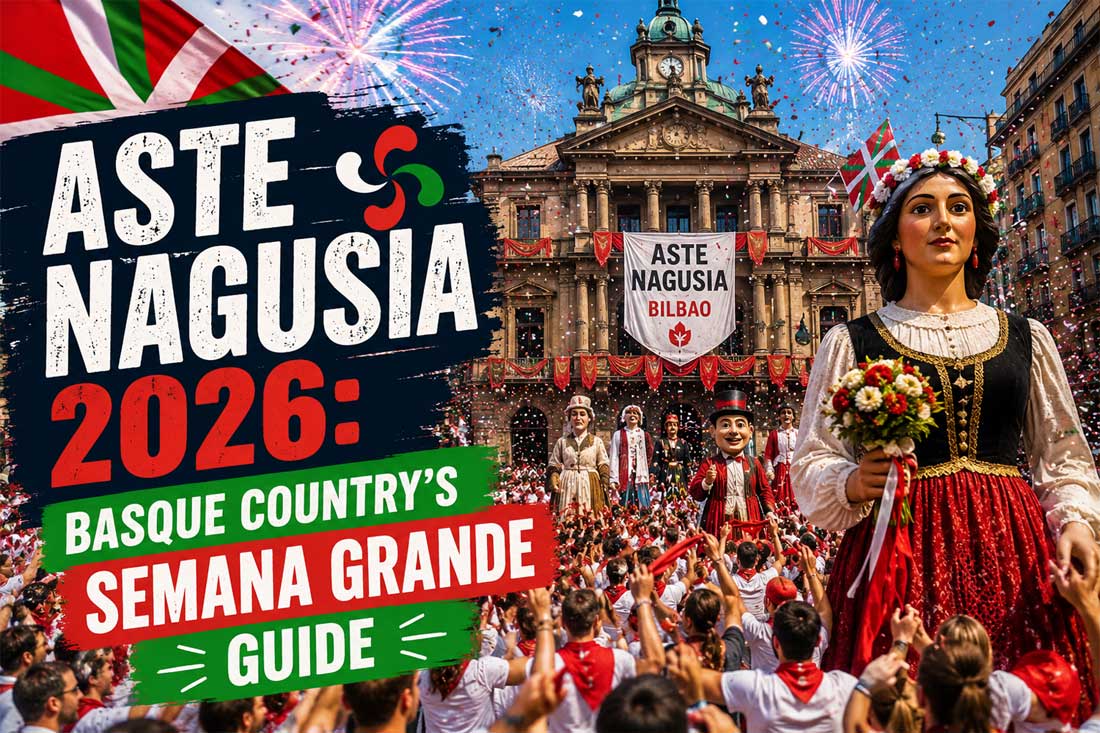
Around the fireworks, the week fills out with concerts at Plaza de la Trinidad, Sagüés and the Boulevard; parades of gigantes y cabezudos (giants and big-heads) winding through the Old Town; herri kirolak — Basque rural sports where competitors chop logs and heave enormous stones; the classic open-water swim from Getaria to San Sebastián; trainera rowing regattas; horse racing at Zubieta; beach volleyball on Zurriola; and toros de fuego for the kids. There are cooking competitions for marmitako, paella and hake in green sauce, because this is the Basque Country and food is never an afterthought.
Bilbao: Marijaia, Txosnas and Nine Days of Noise
Bilbao’s Aste Nagusia is a younger festival with a genuinely charming origin. In 1978, several local associations ran a competition for ideas to give the city a proper summer celebration — up to then, Bilbao had only scattered, minor events. The winning concept became Aste Nagusia, and nearly five decades later it’s one of the most attended festivities in the whole Basque Country.
Everything begins on Saturday 22 August with the txupinazo, a rocket burst launched at the Arriaga Theatre, followed by the opening speech. But the moment everyone actually waits for is when Marijaia appears on the theatre balcony. She’s a giant doll with her arms flung joyfully in the air and an enormous grin — her name means roughly “lady of the festival” in Basque — and she presides over all nine days. The crowd goes genuinely wild when she appears.
The beating heart of the festival is the txosnas: temporary bars and food stands set up in El Arenal by the konpartsak, the volunteer festival collectives that organise and run the whole thing. In 2026 there are 37 of them, alongside craft stalls and food trucks. These aren’t commercial pop-ups — they’re community-run, and drinking a kalimotxo (red wine and cola, a Basque institution) at a txosna is about as close to the real Bilbao as a visitor gets.
Music is everywhere. The programme includes more than 100 free performances across nine venues, with the main stage at Abandoibarra beside the Guggenheim hosting the biggest names each night. Past editions have drawn artists like Rosalía, C. Tangana and Manu Chao. Plaza Circular runs traditional verbena dance bands, the Casco Viejo hosts Basque folk performances during the day, and Plaza Nueva keeps things quieter with chamber concerts.
And yes — Bilbao has its own International Fireworks Competition, launched over the estuary most nights around 10:30 pm. Good viewing spots include the riverbanks near El Arenal, the Campo Volantín promenade, and the Deusto bridge.
Then, on the final Sunday, comes the ending that catches everyone off guard: Marijaia is burned in the square in front of the Arriaga Theatre. Thousands gather to watch. People genuinely cry. It’s a bittersweet, oddly moving farewell that closes the week and sends everyone home.
Practical Tips for Your Trip
Book accommodation early — really early. Both cities fill completely during their respective weeks, and prices climb steeply. San Sebastián in particular is expensive in August. Consider staying slightly outside the centre and using the excellent local transport.
Wear the pañuelo. A knotted neckerchief is the unofficial uniform, and picking one up is a nice way to feel part of things rather than watching from outside.
Bring flat, comfortable shoes. You’ll be on your feet for hours, and the Casco Viejo’s cobbles are unforgiving.
Pack a light rain jacket. Northern Spain isn’t Andalusia — August in Bilbao and San Sebastián can be humid and rain is entirely possible.
Carry cash. Txosnas often prefer it, and queues move faster.
Claim your fireworks spot early. In San Sebastián especially, the good vantage points along La Concha fill up hours ahead.
Earplugs if you’re a light sleeper. The city centre is one continuous party block. This isn’t a complaint about the festival — it’s just information you’ll want at 4 am.
Pace yourself. Nine days is a marathon. Locals treat it as such, mixing late nights with long, slow lunches and afternoon naps. Follow their lead.
Why It’s Worth the Trip
What makes Aste Nagusia special isn’t any single spectacle, though the fireworks over La Concha come close to justifying the journey on their own. It’s that this is a festival Basques throw for themselves. The txosnas are run by neighbourhood volunteers, the music is overwhelmingly free, the sports are Basque traditions rather than tourist demonstrations, and nobody is performing local culture for an audience — they’re just living it, loudly, with the doors open.
You’re welcome to join. That’s the whole invitation. Show up, learn to say kaixo, order a kalimotxo, and stand shoulder to shoulder with a city that’s very good at being happy.
Just don’t be surprised if you find yourself a bit emotional watching a giant doll burn.